For decades, Palestinian women have been living through the unthinkable, without pause and without end. Since October 7th, nearly 85% of Gaza’s population has been forcibly displaced. Israel’s ongoing blockade has cut off food, clean water, electricity, and aid from reaching the people. For women, this means being stripped of every basic condition for dignified survival, such as hygiene products, baby formula, essential medicines, and any sense of normalcy. Menstrual health has become a crisis within a crisis. Pregnant women are giving birth without medical care or sanitation. What remains is bare existence, and even that is under attack.
For those who survive the physical torture and threats of the genocide and war, the psychological impacts are not escaped. The psychological toll is staggering. Since the start of the genocide in Gaza over 75% of women suffer from chronic anxiety and depression (ARDD 2025), with UN Women data revealing that 65% suffer from nightmares, and 62% cannot sleep (UN Women 2025). These are not abstract numbers, they are the real lives of mothers, daughters, and caregivers who are holding entire families together while carrying unbearable weight themselves.
At Healing for Gaza, we see, first hand, this reality reflected in the people who come to us for support. Of the patients we serve, approximately 59% are women. They are not coming to us after the trauma has passed. As HFG has long maintained, what Palestinian civilians are experiencing is not post-traumatic stress, it is ongoing, unrelenting, and actively compounding. The ‘P’ in PTSD does not apply here. Their pain is not something of the past, it is now. And it is only by helping them heal that they can guide, and not just grieve for, the generations to come.
What It Means to Be a Palestinian Woman
Since October 7th, Palestinian women, especially in Gaza, have found themselves suddenly visible to a world that had long looked away.
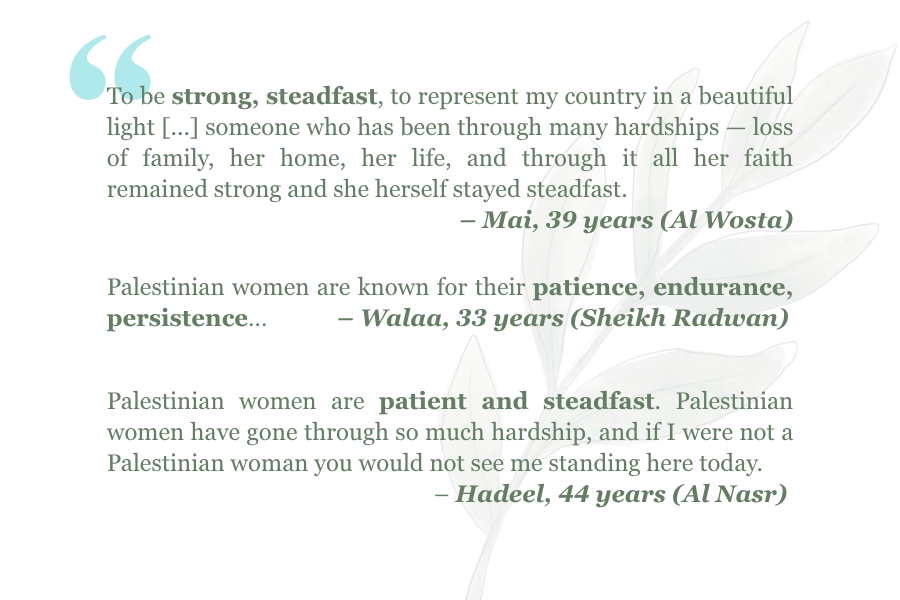
However, with that visibility has come the weight and responsibility of being seen accurately, of representing not just their own pain, but an entire history, an entire people. To be a Palestinian woman is to carry something specific, such as an identity shaped by generations of dispossession, a particular kind of endurance that is both inherited and hard-earned, established through hardships that are theirs alone.
Q: What does it mean to you to be a Palestinian woman?
Motherhood Under the Impossible
Gaza has become one of the most dangerous places on earth to be pregnant. By late 2024, maternal and newborn mortality had risen sharply, as women were dying in childbirth and miscarrying at rates three times higher than before the war (UN News 2025). The blockade stripped away what mothers need most, food, formula for their child’ s survival, hygiene products, the medicines required to safely deliver a baby and keep a newborn alive.
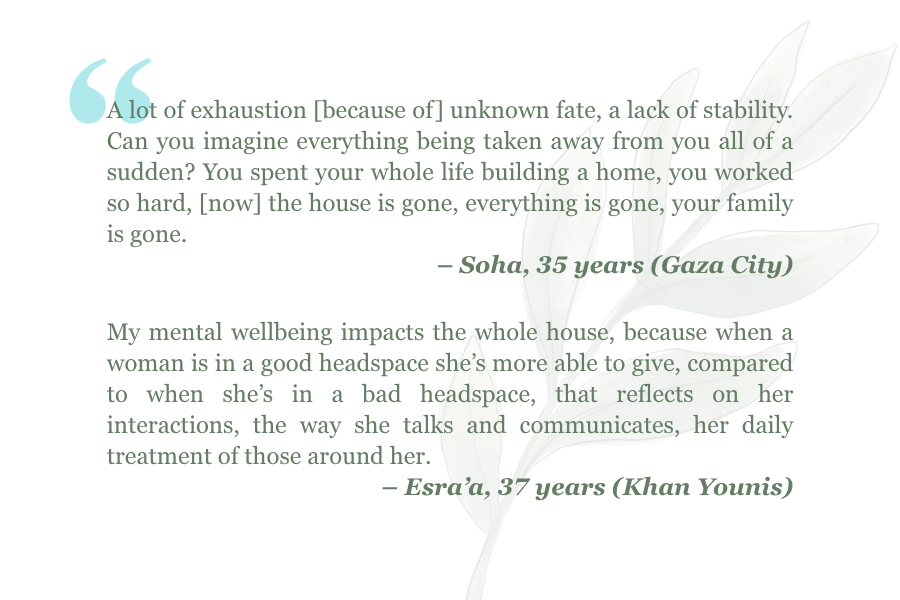
To become a mother in Gaza right now is to do so in conditions designed to make survival impossible. And yet they do. Alongside the physical toll she endures, a mother’s mental wellbeing is deeply intertwined with that of her child. When she is drained, grieving, and without support, the whole household feels it. Her needs are not secondary. They are the foundation.
Q: What do you want people to know about what pregnant and postpartum women in Gaza go through?
The Strength That Was Always There & What Could Not Be Taken
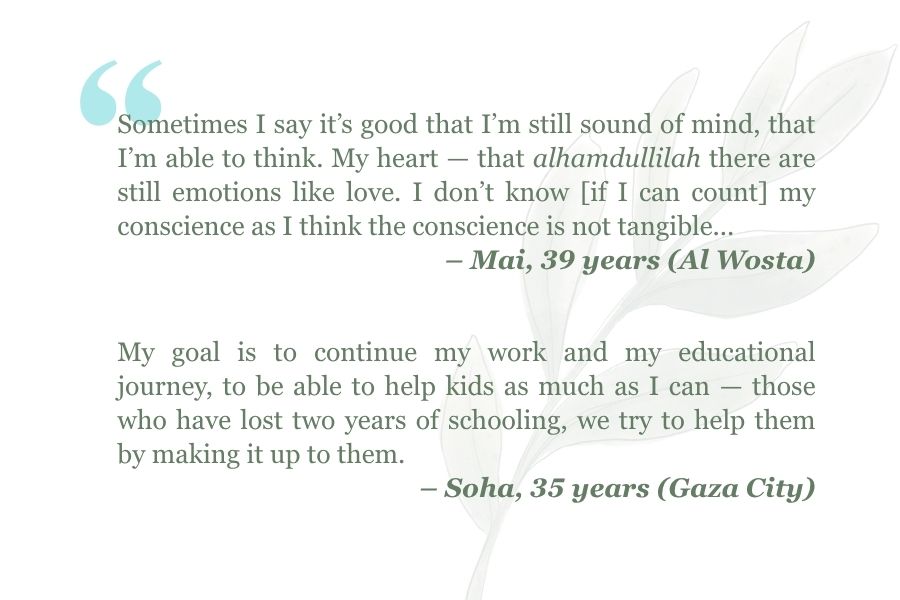
War is not what creates strength in people, it reveals what has always been there. Our women patients, at Healing for Gaza, did not choose to be tested the way they have been. But through the unimaginable, they found reserves of patience, power, and endurance that even they had not known were in them. Again and again, across every conversation, one quality surfaced above all others: immense patience. Not the passive kind, but a deep, active, deliberate steadiness in the face of everything that has tried to break them down and erase them.
Several also spoke of this with a quiet relief, expressing “alhamdullah” that they are still sound of mind, still able to feel. That is not a small thing when everything else has collapsed around you. In the midst of colonial violence, ethnic cleansing, and genocide, their minds, their hearts, and their conscience held.
What no occupation can legislate, no airstrike can reach, and no blockade can strip away is their humanity, their capacity to grieve and to love, and their insistence on continuing to live. That, these women made clear, belongs only to them.
Q: What strength did you find in yourself that you didn’t know you had?
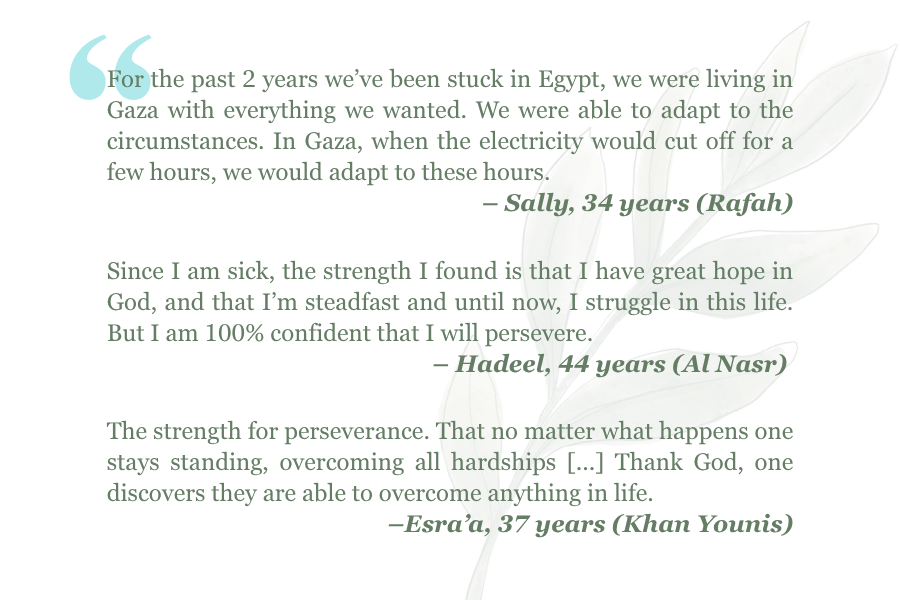
Q: What part of you stayed strong and was not affected by everything?
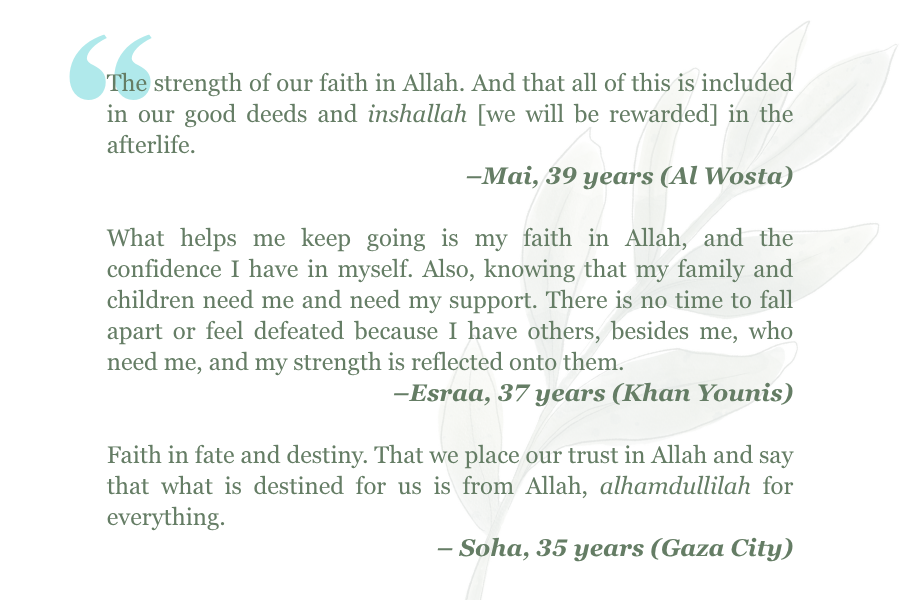
Faith as Foundation
For Palestinian women, faith is not a coping mechanism, instead it is the very foundation of how they move through the world. Across every conversation, iman was the first thing these resilient Palestinian women named when asked what keeps them going. Not as an escape from reality, but as an anchor to it.
Faith is what keeps many of those who are suffering present, what stops them from losing themselves entirely to grief, and what reminds them that their suffering has weight and their survival has meaning.
Q: When everything in life is hard, what gives you the motivation to push through?
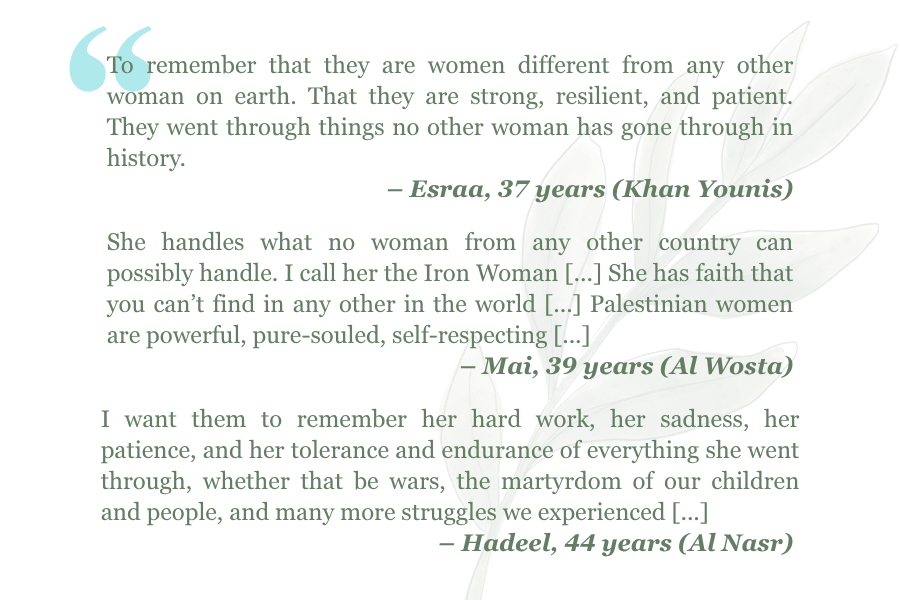
The World Needs to Remember
Palestinian women did not ask to be symbols. One voice described the Palestinian woman as the Iron Woman. Faithful. Patient. Strong. Carrying a weight of endurance that no other woman on earth has been asked to carry in quite the same way.
The world needs to sit with that, not as inspiration, not as spectacle, but as an eye opener of the realities they are forced to bear with. To hear these women on their own terms, in their own words, is not optional. It is the bare minimum of what they are owed. They are speaking their truths and we must bear witness to their suffering, understand them, and not look away again.
Q: What would you like people to remember about Palestinian women?
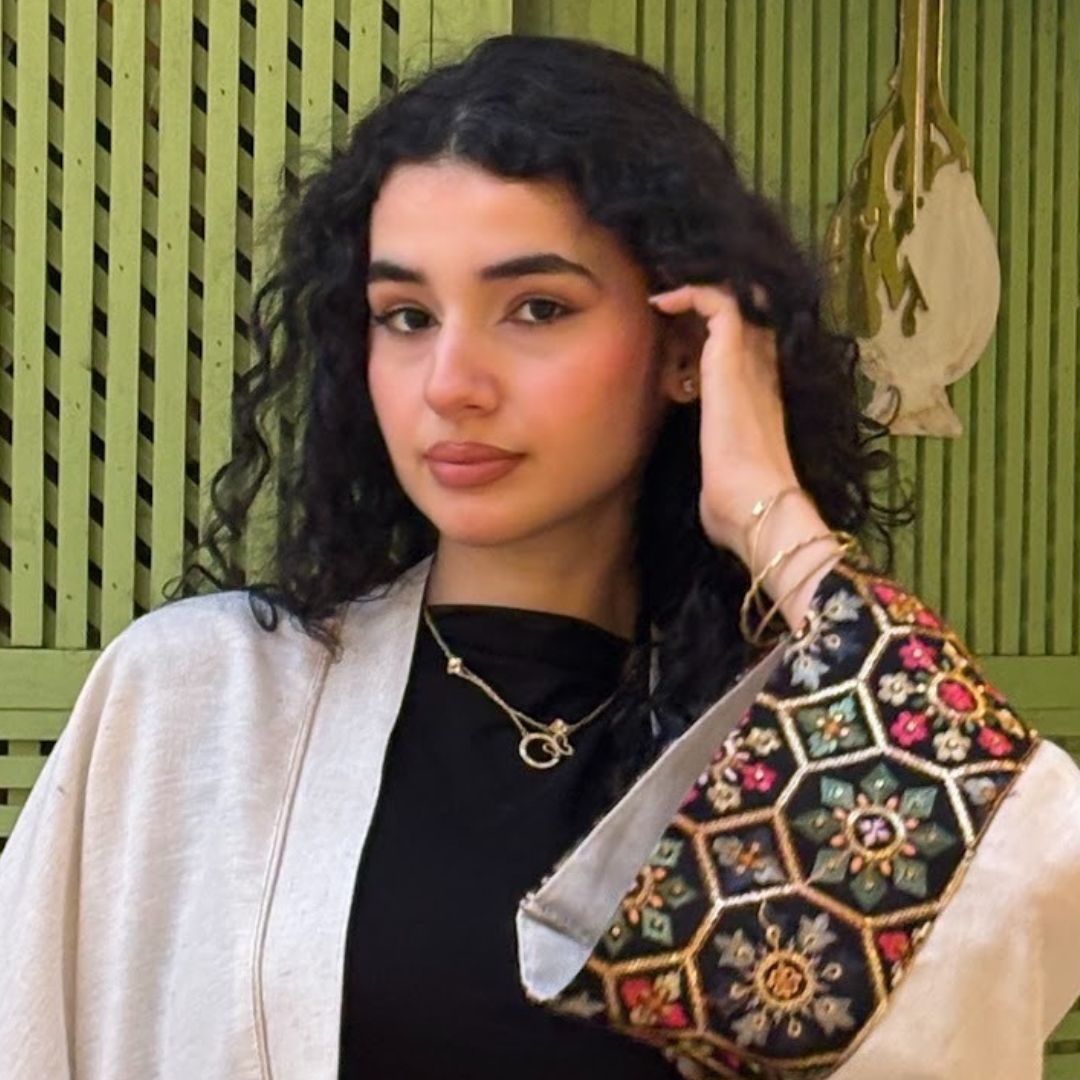
Diana Almasri is a Syrian-Antiguan, holding a BA in International Relations and Area Studies from Jagiellonian University, with specialisations in International Security and SWANA Studies. Diana currently serves as Communications Intern at Healing for Gaza and a Communications Co-Lead at Climate Sirens


